A submission to the University of Bristol in accordance with the requirements of the degree of Doctor of Philosophy by Publication in the Faculty of Medicine, 2006
Child Maltreatment in the
‘Children of the Nineties’
As a paediatrician I have long been fascinated by parenting, what constitutes parenting and why it sometimes goes wrong. Faced with children suffering as a result of child abuse, the obvious question is “Why?” As a father the question shifted to why it doesn’t go wrong more often. In the words of one of the mothers I interviewed, Some people seem to think that you just have children, you bring them up and that’s it. But it doesn’t work out that way. It’s hard.
The work presented in the seven papers for this PhD by published research represents the output of 9 years of research into risk factors for child abuse, carried out through the Avon Longitudinal Study of Parents and Children (ALSPAC). My motivation for undertaking this work stemmed from my work as a community paediatrician, particularly in the field of child abuse and neglect.
Read more about this thesis
The work presented in the seven papers for this PhD by published research represents the output of 9 years of research into risk factors for child abuse, carried out through the Avon Longitudinal Study of Parents and Children (ALSPAC). My motivation for undertaking this work stemmed from my work as a community paediatrician, particularly in the field of child abuse and neglect.
Approaching the reality of so many children’s lives and the challenges of parenting, I also struggled with some of the literature on child abuse which seemed to give simplistic explanations that didn’t match up with the complexity of family interaction that I observed in clinical practice. To label abusing parents as all psychologically disturbed or maliciously cruel didn’t seem to fit the majority of parents that I dealt with, most of whom seemed genuinely to love their children; nor did it make sense to attribute such abuse and neglect simply to the consequences of poverty or deprivation, since the majority of families in the sometimes very deprived communities in which I was working, did not abuse their children.
The Avon Longitudinal Study of Parents and Children provided an ideal opportunity to study the subject in depth. The wide range of data in the study and its prospective nature meant that it could accommodate some of the complexity of the field and overcome some of the limitations of other research.
My role as a practicing paediatrician and my personal experience of parenting as a father both provided a stimulus for initiating this research and helped to define some of the questions I asked, and how I interpreted the results. However, the converse is also true, and carrying out this research also changed me. I learnt a lot about parenting that I might never have encountered through my personal experience or professional practice. My background reading for the project exposed me to a wealth of information on children’s development and needs. The rigour of undertaking a research project emphasised to me the importance of having an evidence-based approach to clinical practice, but also highlighted some of the limitations of such approaches.
The emerging results from the study altered my perceptions of child maltreatment and the complexity of family and environmental interactions that influence the parent-child relationship, and I believe this enabled me to be more empathetic, whilst at the same time taking an objective and comprehensive analytic approach to family difficulties. The subject matter of the research also shaped my own professional development, with an increasing specialisation in child protection work, both at a clinical level and in policy and strategic thinking both locally and nationally.
Patterns of child abuse and neglect
In order to study patterns of child abuse in a pre-school population, we looked at children within the ALSPAC cohort who had been investigated for abuse or placed on the child protection register. More…
Of 14,138 children enrolled in the cohort, 329 were investigated for suspected child abuse and 162 were placed on the child protection register over an 8-year period, representing rates of 10.6 – 23.3 per 10,000 per year. Physical injury and neglect accounted for 31.7% and 29.0% of registrations in the study group respectively, these proportions being similar to those for children of all ages in Avon. In contrast, sexual abuse accounted for 10.9% compared to 20.8% for all ages. Emotional abuse represented just 2.8% of investigations but 25.1% of all registrations in the study group, compared to 14.4% of registrations for all ages. 255 (1.8%) parents reported physical cruelty to their children by themselves or their partner at some stage in the first three years; 772 (5.4%) reported some emotional cruelty.
The importance of emotional cruelty to children is increasingly being recognised by professionals, but even more so by parents, whose concerns relating to both physical and emotional cruelty are not being identified by current procedures.
This paper was published in Child Abuse and Neglect:
PD Sidebotham, The ALSPAC study team. Patterns of child abuse in early childhood, a cohort study of the “Children of the Nineties”. Child Abuse Review 2000; 9: 311-320
Parental factors affecting maltreatment
My analysis of risk factors within the ALSPAC cohort started with a study of parental backgrounds, published as PD Sidebotham, J Golding, The ALSPAC study team. Child maltreatment in the ‘children of the nineties’: A longitudinal study of parental risk factors in Child Abuse & Neglect, the International Journal 2001; 25: 1177-1200. More…
Using logistic regression analysis, significant risk factors within the mothers’ backgrounds were age <20; lower educational achievement; history of sexual abuse; child guidance or psychiatry; absence of her father during childhood; and a previous history of psychiatric illness. Significant factors in the fathers’ backgrounds were age <20; lower educational achievement; having been in care during childhood; and a history of psychiatric illness. Significant factors on univariate, but not multivariate analysis included a parental history of childhood physical abuse; divorce or separation of the mother’s parents; a maternal history of having been in care, or separated from her mother; parental alcohol or drug abuse; and a maternal history of depression.
My results support the findings of others that parental age, educational achievement and a history of psychiatric illness are of prime importance in an understanding of child maltreatment.
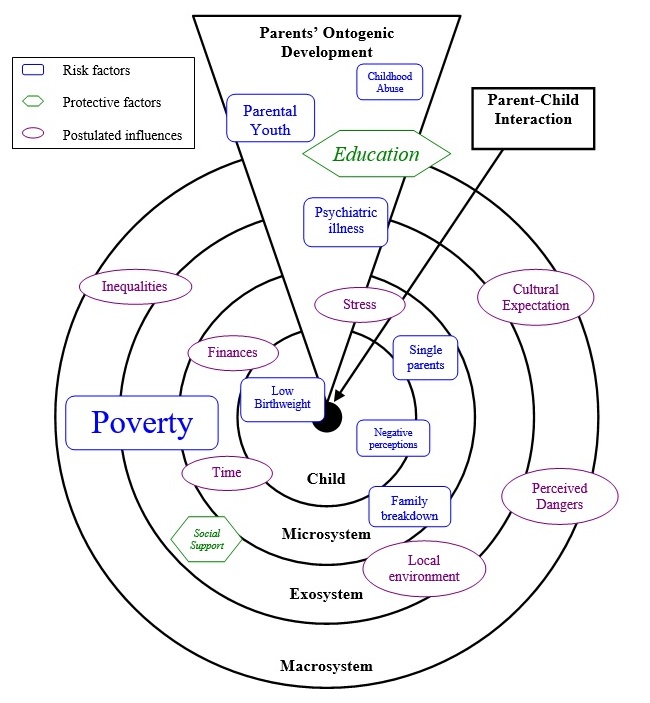
Even at this very early stage of the research, it was clear that complex relationships exist between parental background factors and other levels of the ecological model, particularly socio-economic factors. Whilst psychodynamic theories are important, they are not, in themselves, adequate models to explain child maltreatment. The concept that abusing parents are somehow different or abnormal is not supported. My findings suggest that strategies to prevent teenage pregnancies and to work with and support young parents could be effective in reducing child maltreatment and should be evaluated with this outcome in mind. They also support strategies to encourage and facilitate full secondary education for all, including measures to ensure that teenage parents are not denied opportunities for education. I would emphasize however that this knowledge should be used not to label young parents as “potential abusers,” but to support such parents in the very difficult task of bringing up their children.
More to follow on this research. Watch this space.